
San Francisco, CA · Castro · Variety & hardware store · Founded 1936
Cliff's Variety
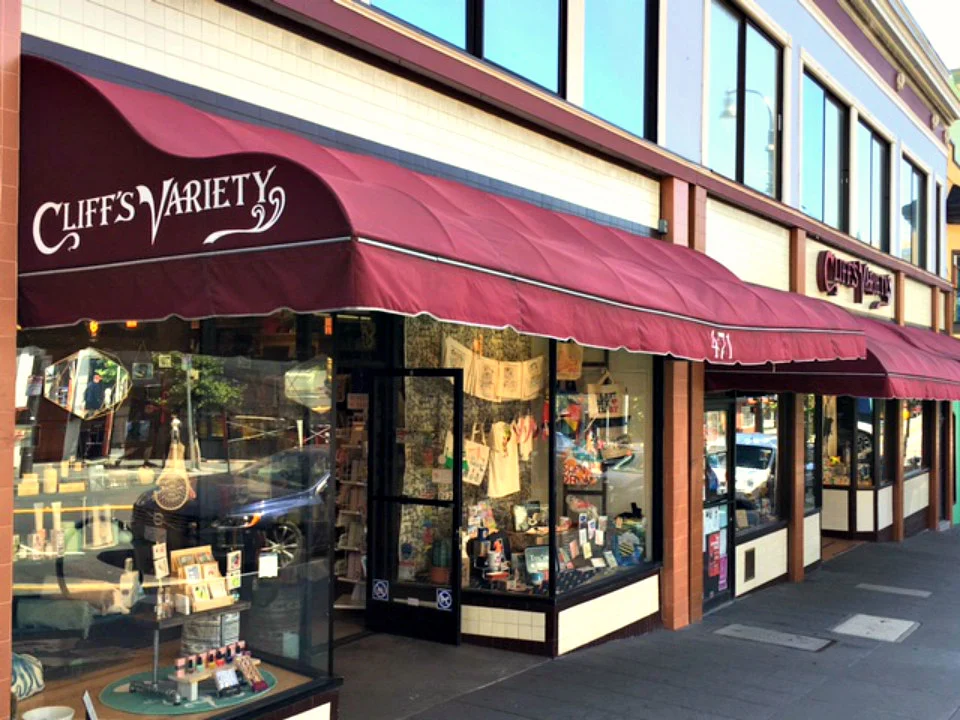
Interviewed 2026
History
Cliff’s Variety opened in 1936. It was started by the great-great-grandfather of the current owner, Terry Asten Bennett, who was a retired schoolteacher from New Mexico. He came to San Francisco by way of Los Angeles, and the store started out selling magazines and used greeting cards. This was still during the Depression, and they used ink eradicators to take the writing out of greeting cards so they could be sold again, which Terry describes as “your original recycling.”
He named the store Cliff’s Variety after his youngest son, Clifford, who was a saxophone player and taxi driver. He hoped that by naming the store after him, Cliff would take over and “get a real job.” Cliff never worked there. Instead, Terry’s great-grandfather Ernie DeBaca became involved with the store. Ernie was a fix-it man in the Tenderloin who could fix anything. After a motorcycle accident crushed his leg, he started fixing things in the back of his parents’ shop while he recovered. That was how Cliff’s started carrying hardware.
Cliff’s has always been a variety store. It started with magazines and used greeting cards, but it also had toys, sewing notions, and “little odds and ends.” By the 1940s, it was carrying hardware. Since then, the store has “very much morphed and changed with the needs of the neighborhood.”
As people in the neighborhood began fixing up the old Victorians, Cliff’s started carrying hand-cast plaster medallions based on original Victorian designs. Terry said the store has carried them since around the late 1970s or early 1980s. As the neighborhood continued to change and drag became part of the culture of the Castro, Cliff’s began carrying boas, tiaras, drag queen shoes, and eyelashes. As Terry put it, the store has “morphed and changed with what we needed and what the community needed.”
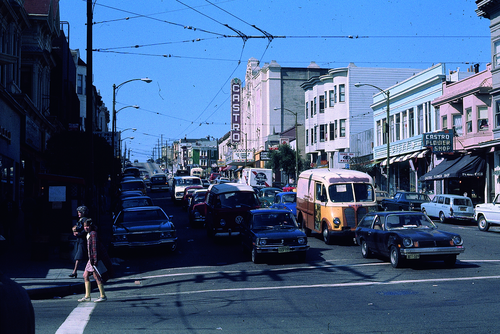
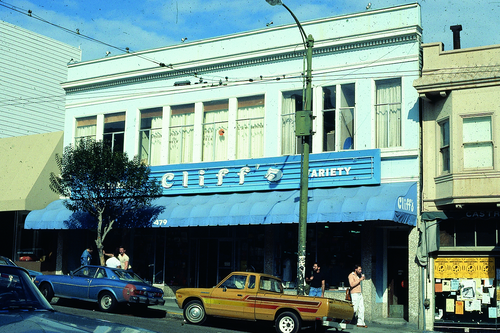
Cliff’s has always been within the same two blocks of Castro Street. Before moving into its current building, it was down the block in a space where a bagel shop and taqueria are now. In 1971, their landlord was going to triple the rent just as the current building came up for sale, so the family took the opportunity to buy it. Cliff’s has been there ever since.
CLIFF’S ON CASTRO STREET, 1975
About the Interviewee
Terry Asten Bennett is the fifth-generation owner of Cliff’s Variety. She worked at the store as a kid and in high school and has been there consistently since graduating from college in 1997. As the owner, she is responsible for everything from HR and IT to buying merchandise. As Terry explained, “As a small business owner, you basically do everything yourself.”
Years ago, Terry’s parents were offered a lot of money to sell the business. They took Terry and her sister out to dinner and asked whether they should consider selling or whether one of them wanted to take it over. Terry took a minute to think about it, and then it became clear to her that she did not want to see what the Castro would look like without Cliff’s. She felt that so much of the daytime culture of the neighborhood was built around the vibrancy the store provided. She also felt that if the family sold it, she would have to leave because she “couldn’t stay here and face the community” if she did not keep the store going.
Today, what keeps Terry motivated is the people. She has been spending more time doing door shifts downstairs and talking to customers, which she describes as “so emotionally fulfilling.” She gets to see how happy people are to walk into a store where they can touch and see things, talk to someone, and get help finding what they need. “That’s really what keeps me going,” she said, especially because financially, running the store is difficult right now.
Economy and Changes Over Time
Terry describes San Francisco as a place that is “always changing,” and Cliff’s has seen those economic ebbs and flows over the years. Right now, she sees the city changing rapidly again as rents rise and things become more expensive. One of her biggest concerns is what that means for her employees. Cliff’s is a retail job with retail wages, and if employees have to move, Terry worries about how difficult it can be for them to find another place that is economically viable.
She believes the larger affordability crisis cannot be addressed without dealing with the supply and cost of housing. While Terry believes people should be able to make a living wage, she said that raising wages alone does not solve the problem when housing remains unaffordable. For a small business, those costs do not come from nowhere, and increases in expenses affect what the store has to charge.
Retail itself has also gotten harder. Terry said the pandemic made it more difficult as people became accustomed to shopping through Amazon, Temu, and other places where they could buy something from their phones in the middle of the night. Cliff’s cannot sell things for the same prices because it has employees to pay, insurance, and the cost of keeping the lights on. “You have to make a certain amount of margin,” Terry explained. “You can’t just give things away for pennies on the dollar.”
The pandemic was one of the most impactful moments in the store’s recent history. Cliff’s had to change “on a dime” how it could do business while figuring out how to keep its employees safe. Terry said that while most businesses talk about putting the customer first, at Cliff’s, “we believe in taking care of our employees first, actually.”
That meant finding masks before they were widely available. Cliff’s worked with a clothing store across the street whose seamstresses were out of work and making fabric masks. The owner also helped Terry source KN95 masks from China. Terry sees that experience as part of the reason employees stay at Cliff’s for so long. The average employee has worked there for more than 20 years. At the store’s 90th anniversary, Cliff’s recognized employees who had been there for more than 30 years. Terry joked that if they had recognized everyone who had been there for 20 years, “it would have been half the staff.” Five people out of a staff of 37 had worked there for more than 30 years.
More recently, tariffs have made the financial pressure even greater. Terry said the cost of some plumbing parts doubled overnight when metal tariffs went into effect. Seasonal goods were also affected. She has to place Christmas orders in January, so when tariffs came in after those orders had already been placed, she saw increases of 40 to 50 percent in the cost of some items when they shipped from suppliers. There was not enough margin for either the suppliers or Cliff’s to absorb all of those increases, so the cost of goods went up.
There are months when the finances are so tight that Terry does not pay herself because she has to pay medical insurance, her employees, and the cost of goods. That uncertainty has also made her question whether she would want her daughter, who recently graduated from college, to become the sixth generation to run Cliff’s. Terry does not know whether her daughter will take over. “I like my kid,” she joked, and in the current state of retail, she cannot imagine wishing it on her. At the same time, she does not want to see Cliff’s go away.
Terry has also seen how government decisions can affect businesses like Cliff’s. She believes that local government sometimes forgets about the businesses people depend on when things go wrong. During an earthquake or power outage, hardware stores are the places sourcing batteries and other supplies. During the pandemic, they were finding alternate sources for hand sanitizer, masks, and cleaning supplies. As Terry put it, “we’re not glamorous and we don’t have big lobbyists,” but those businesses still need to be remembered when local government makes decisions.
She gave the example of a change to San Francisco’s gross receipts tax. A $5 million cutoff may sound like a lot of money, Terry explained, but a hardware store can sell a large amount of merchandise without making a large amount of profit on each item. Cliff’s taxes doubled after the change. Terry said the store is fortunate to have a close relationship with its district supervisor, who has been working on legislation to address the problem. For small businesses, she said, it can otherwise be difficult to have their concerns heard: “Hardware stores don’t have lobbyists. We don’t have extra money to pay big fancy people to make the laws work in our favor.”
Through all of these changes, Terry believes a business has to be willing to change too. Her advice is to “have a plan and be able to pivot,” because if something is not working, “you don’t want to sink and die with it.” To thrive, she believes a business has to be humble enough to recognize when something is not working and change course.
CLIFF’S ON CASTRO STREET, 1978
Community
For Terry, “the store is more than about business, it’s about community.” Cliff’s has regular customers who have shopped there since she was an infant and others who come in three or four times a day. The store has also grown up alongside the businesses around it. Terry remembers Marcello’s across the street and Rossi’s Delicatessen being there for essentially her entire life, while other longtime businesses have helped make the Castro what it is.
Cliff’s also has a relationship with Harvey Milk Civil Rights Academy, the public elementary school a couple of blocks away. Terry went there when it had a different name, and her daughter later attended the school as well. Cliff’s supports the school, and the school supports Cliff’s. For Terry, that is how a community works: “When you take care of your community, you’re taking care of yourself because, you know, when everybody succeeds, you succeed.”
The community has done the same for Cliff’s. Terry describes the customers as “so loyal and so amazing.” Neighborhood groups have told her that if the business is ever in trouble, she needs to tell them before it is too late because “they depend on us and we depend on them.”
For Cliff’s 90th anniversary, the store held a fundraiser for the Castro Country Club and the school. In one month, the community helped raise almost $20,000 for the two organizations. Cliff’s then held a celebration on the street. Old employees came back, along with customers who had moved away but wanted to return for it. Terry sees that relationship as connected to the fact that people can leave the neighborhood, come back years later, and still see some of the same employees on the floor.
To Terry, that relationship is not limited to Cliff’s. “I think small businesses play huge roles.” They hire people from their own communities, and when someone in the community needs support for a fundraiser, small businesses are often where they go. She describes it as “a very cyclical and symbiotic relationship that when a business takes care of the community, the community takes care of the business.”
The Castro, to Terry, is “like walking into Cheers, like everybody knows your name.” It can take her a long time just to walk a couple of blocks because she stops to talk to so many people. But she does not think that kind of relationship has to be unique to the Castro. Sometimes investing in a community simply means investing in its people: getting off your phone, looking people in the eye, saying hello, and introducing yourself to your neighbors. “When people know you, they want to look out for you.”